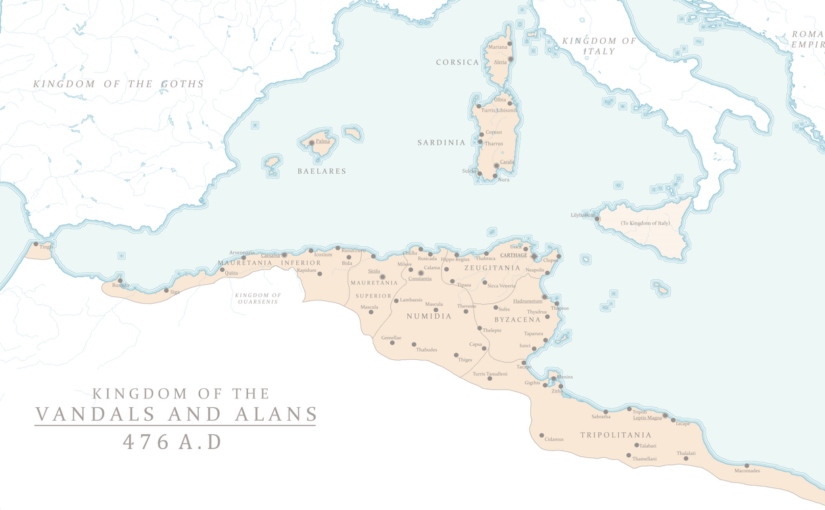
There are episodes in history that resist the tidy categories we impose upon them, and the Vandal sojourn in North Africa is surely among the most stubborn. For nearly a hundred years, from 435 to 534, a people born of northern forests presided over olive groves and azure harbors, ruling from Carthage as if the geography itself were a wry comment on the fluidity of empire. Theirs was not, despite the calumnies of later centuries, a tale of mere ruin; it was a chapter of reinvention, written in marble and mosaic, in coinage and confiscated basilicas, along a coastline that has always been a palimpsest.
The story opens in 429, when some eighty thousand souls, gathered under the unyielding gaze of Geiseric, crossed the strait from Hispania into a continent that was less a destination than a destiny. They were not, as the chroniclers would have us believe, a swarm of unreasoning marauders; they were a people in search of permanence, picking their way eastward through what we now call Algeria and Tunisia. The Western Empire, sagging beneath its own contradictions, attempted in 435 the time-honored gesture of the weakening state, a treaty conceding Numidia and Mauretania in exchange for the fiction of alliance. Geiseric accepted the gift and prepared to take the rest.
On the nineteenth of October in 439, while the patricians of Carthage were absorbed in the choreographed thunder of chariot races at the hippodrome, his forces slipped through the gates. There is a kind of dark theater in the timing, an almost classical understanding of distraction. The ancient Phoenician port, Rome’s granary and its mirror, had changed hands without ceremony, and from its marble forums Geiseric proclaimed himself King of the Vandals and Alans, honoring the steppe horsemen whose loyalty had carried him this far.
What followed was a maritime imagination rare among the Germanic kingdoms of the age. Within a decade, Vandal fleets had taken Sicily, Sardinia, Corsica, Malta, the Balearics, and with them the arteries of Roman trade. The sack of Rome in 455, that event so beloved of later moralists, was less an act of vandalism in the modern sense than a calculated demonstration of reach. Carthage prospered on grain and tariff, on the steady pulse of commerce that Geiseric had learned to throttle or release as policy demanded. The Western Empire, deprived of its African harvests, grew thinner by the season.
That the kingdom endured ninety-nine years, while sister realms across the post-Roman world flickered out within decades, suggests a governance more subtle than its reputation allows. After Geiseric’s death in 477, an uneasy choreography with Constantinople preserved a peace built upon mutual suspicion and economic necessity. But Byzantium did not forget. In 533, Justinian dispatched Belisarius on one of those campaigns that historians describe as lightning, perhaps because the metaphor spares them the labor of explaining how quickly a century can collapse. At Tricamarum in December, the Vandal lines broke with the death of the commander Tzazo, and King Gelimer, after a long, hungry vigil on Mount Pappua, surrendered the following year. North Africa folded back into the Byzantine fold, and the Vandals, as a distinct people, simply dissolved.
At the heart of their century lay a theological wound that would shape how posterity remembered them. The Vandals were Arians, holding Christ subordinate to the Father, and they ruled a population devoutly Nicene. From their arrival, the doctrinal fault line widened into policy: basilicas seized, bishops exiled, the Arian clergy elevated to the offices their rivals had once held. Under Huneric, who reigned from 477 to 484, the pressure became a kind of liturgy of its own. Bishops were sent into the desert; churches were taken; resisters were tortured or killed. The chronicler Victor of Vita, whose pen would shape a millennium of judgment, recorded the humiliation of Bishop Eugenius of Carthage with the unsparing fervor of a witness who knows his testimony will outlive his tormentors.
Modern scholarship, more inclined to suspicion of saints’ lives, reads these persecutions as instruments as much as convictions. The Catholic hierarchy was, in Vandal eyes, a fifth column aligned with Constantinople, and Arianism a useful seam of identity in a kingdom otherwise threatened with absorption into the Roman sea around it. Faith here was both sword and shield, sharpened on the whetstone of political necessity.
Yet to read the Vandal century only through the lens of religious violence is to mistake one register of life for the whole. Beyond the contested altars, society moved in patterns far more interwoven than the chroniclers admit. Archaeology has begun to whisper what literature withheld: Vandal nobles reclining in Roman villas, taking to the toga and the symposium; local elites adorning themselves in Germanic jewelry, embracing the banquets of their new neighbors. The scholarly culture of late antiquity did not perish but found patronage, and historians such as Averil Cameron have suggested that for many North Africans, Vandal lordship may have lifted, rather than imposed, a yoke, replacing absentee Roman landlords with a more proximate, if more peculiar, master.
The excavations at Carthage record this in stone: walls weathered and patched, forums repurposed to new uses, all of it layered into the city’s long Punic-Roman-Byzantine biography. The markets did not fall silent; the mosaics continued to be laid. The Vandal interval was less a rupture than a modulation, an inflection of the African Roman voice rather than its silencing.
Sovereignty announced itself most legibly in the coinage struck at Carthage from 439 onward. Bronze nummi and gold solidi bearing Geiseric’s mark traveled with the merchants who had always traveled, surfacing in Egyptian sands and Sicilian hoards, threading commercial filaments that survived the political fabric. When Byzantine mints replaced Vandal ones after 534, they did so in the same halls, perpetuating the flow with only the quietest adjustment of iconography. The Vandals had adapted Roman bureaucracy with the discipline of pupils who intended to surpass their teachers; they taxed fields and harbors with efficiency, and their command of the grain fleets had been, in the end, one of the slow knives that bled the Western Empire to death.
There is something philosophically vertiginous in the afterlife of the word itself. The Vandals, whose reign was on balance measured, who preserved more than they destroyed, who bequeathed to their Byzantine successors an apparatus largely intact, lent their name to the very concept of wanton destruction. The slander is a medieval bequest, refined by Enlightenment polemic, and it tells us a great deal about how Europe has chosen to remember its barbarians, and rather little about Geiseric.
What remains, for those who walk the forums of Carthage or trace the contours of Dougga’s terraced hills, is a more nuanced inheritance. The Antonine Baths still hold the light as they did when Vandal patrons commissioned the restoration of their mosaics. At Utica, where the conquerors first set their boots upon African soil, the harbors lie quiet beneath wildflowers, and the small archaeological collections preserve the nummi that once carried Geiseric’s profile to distant ports. Dougga, lifted into its hills, continued to produce its grain and stage its civic life almost without interruption, the Vandal century registering in the archaeological record as a faint adjustment rather than a caesura. Further west, near Teboursouk, the terrain that frustrated Gelimer’s last defenses still rises in stubborn folds, indifferent to the empires that have contested it.
The Vandals vanished with uncommon completeness. Their language faded, their customs dissolved, their artifacts proved on closer inspection to be Roman things touched lightly by northern hands. They left behind no diaspora, no successor kingdom, no liturgy in their own tongue. What they left was a bridge: a hundred years during which the Roman order in North Africa did not collapse but was held, transformed, and handed on. In a Mediterranean that has always preferred synthesis to purity, theirs was perhaps the most Mediterranean fate of all, to be absorbed so thoroughly that the very memory of their presence became a slander, and the slander itself a kind of monument.
Walking Through Vandal Africa
For a Vandals-focused or archaeology-heavy trip through Tunisia, these local operators and private guides are among the strongest options for arranging custom itineraries to sites like Carthage, Dougga, Bulla Regia, Uthina, El Jem, and the southern desert regions.
Specialist Archaeology & History Tours
- Le Lemon Tour — Based in Carthage and especially useful for Punic, Roman, and late antique history tours around Tunis, Carthage, and Sidi Bou Said. Their local guides are well suited for travelers interested in Vandal-era North Africa.
- WildyNess — A Tunis-based operator known for tailor-made cultural and adventure itineraries, including historical circuits and Sahara extensions.
- HISTORY TRAVEL HAMMAMET — Focuses on historical excursions from Hammamet and Tunis, including Dougga, Kairouan, and Roman archaeological routes.
- Tunisian Freedom Tours — Offers customizable heritage tours with drivers and guides, useful for multi-day private itineraries.
Private Guides & Boutique Operators
- Xperience Tunisia — Boutique operator running private, customizable journeys with strong UNESCO and archaeology-focused itineraries. Their “Ancient Tunisia” tour is especially relevant for Roman and Vandal history enthusiasts.
- GSA Voyages — Known for fully private custom tours with dedicated guide and vehicle, including archaeology and desert routes.
- Tunisia Guided Tours — Strong option for day trips to Dougga, Bulla Regia, Uthina, and Zaghouan. Useful if you want structured archaeology-focused excursions without organizing logistics yourself.
- Didon Tours — Offers numerous private archaeological excursions, including Dougga, Bulla Regia, Kairouan, El Jem, and Carthage.
- Activity Tunisia — Flexible private excursions with transport included; practical for combining coastal and inland heritage sites.
Sahara & Southern Tunisia Specialists
If you want to connect the Vandal-era north with Berber and desert landscapes farther south:
- Simba Fun Travel Tunisia — Strong reputation for Sahara and southern Tunisia routes, including Douz, Tozeur, and troglodyte villages.
- Agence Voyages Tunisie – Agencia Viajes Túnez Desert Rose — Well-reviewed for private desert circuits and multilingual guiding.
Useful Historical Sites to Mention When Booking
Many operators will customize itineraries if you specifically request: