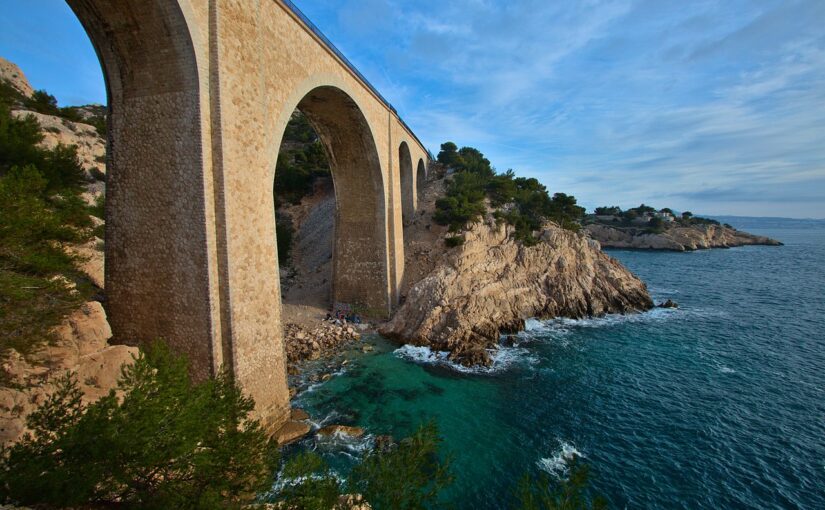
Light falls differently on this stretch of coast. West of Marseille, where the limestone breaks into a series of small theatrical gestures above the sea, the Mediterranean assumes a particular shade of indigo that the painters of the last century could never quite leave alone. Renoir paused here. Cézanne measured its planes. Dufy distilled it into pennants of color, and August Macke, in the brief sunlit months before the trenches claimed him, found in these horizons a vocabulary of joy. The Côte Bleue, as it was eventually christened, has always seemed less a place than a palette.
A single railway threads this coastline, and to ride it is to participate in something close to an act of memory. The Train de la Côte Bleue runs some sixty kilometers between Marseille and Miramas, an unhurried itinerary of twenty-three tunnels and eighteen viaducts that has somehow escaped the great twentieth-century compulsion toward speed. It is the Riviera’s quieter sister, removed from the gilded clamor of Nice and Cannes, where pine shade still falls across empty coves and the painted wooden pointus, those stubby Provençal fishing skiffs, still nose out at first light as though the past century had forgotten to occur.
The journey begins, properly, with a descent. Marseille Saint-Charles presides over the city from its limestone promontory, and the hundred and four steps that spill from its forecourt are guarded by stone lions and allegorical figures of distant continents, a Belle Époque fantasy of empire and arrival. To emerge from the station is already to feel the theater of departure, even before the train has whispered its first kilometer westward.
What follows is less a transit than a slow unfurling. The track adheres to the cliff with the patience of a Roman aqueduct, slipping in and out of darkness, then revealing, in sudden lyric panels, a turquoise inlet, a bone-white beach, a ridge of garrigue trembling with wildflowers. At Niolon, the platform hangs above a horseshoe harbor so modest it seems half-imagined, with a viaduct arcing overhead and the first ramparts of the Calanques opening to the east. Divers gather here now where smugglers once did; the old customs path still winds toward the Calanque de Méjean, austere and crystalline.
Further along, Carry-le-Rouet offers the warmer pleasures of a small resort that has resisted becoming a spectacle of itself. Its café terraces, its little harbor, its winter festival of sea urchins eaten on the sand with cold white wine, all suggest a civilization still committed to the proposition that lunch is a serious matter. Sausset-les-Pins, more reticent still, preserves the modest dignity of a former tuna port; its Corniche meanders past coves and outcrops in the manner of a sentence that refuses to end. And then, past the industrial intrusion of Martigues and Fos, the train performs its strangest trick: for a moment near Istres, it appears to skim the pink saltwater lagoons, as though the rails had been laid upon the water itself.
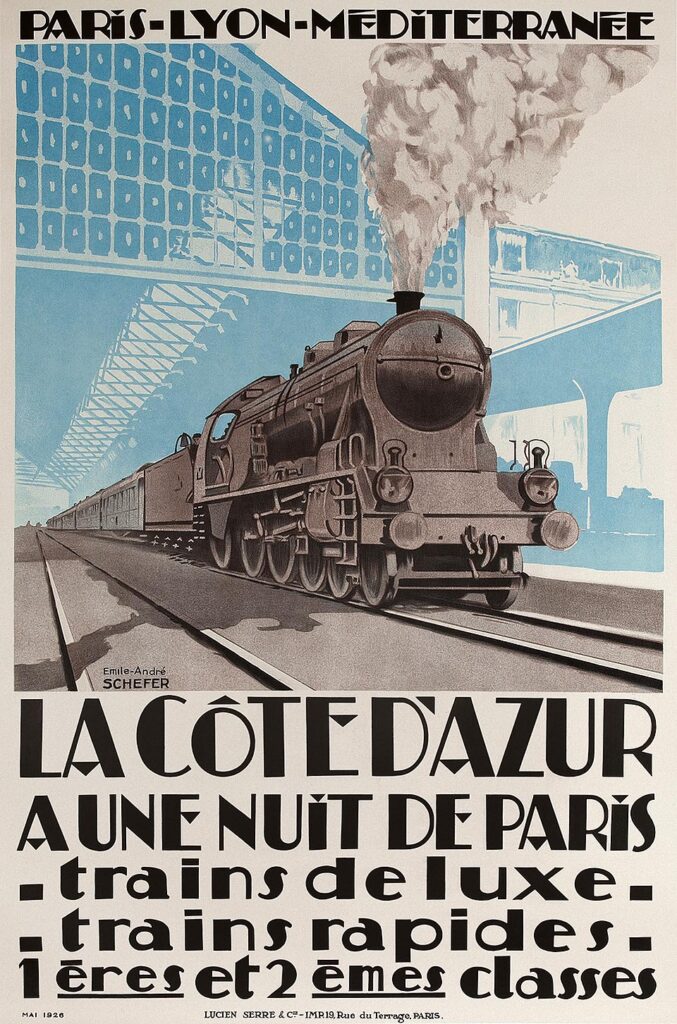
There is another blue train, of course, and it would be impossible to ride this coast without summoning its ghost. The Calais-Méditerranée Express, known to everyone as the Train Bleu, descended each winter from the Channel to the Riviera between 1886 and 2007, with only the interruption of war. After 1922, when the Compagnie Internationale des Wagons-Lits dressed its sleeping cars in that famous deep cobalt livery, the name became less a designation than an incantation. Kings traveled on it. So did Coco Chanel, the Aga Khan, Scott Fitzgerald in his less prudent seasons, and a parade of dukes whose names now exist only in memoirs.
The train acquired the cultural gravity such things sometimes do. Diaghilev commissioned a ballet around it in 1924, with a curtain by Picasso, costumes by Chanel, libretto by Cocteau, music by Milhaud: a constellation of talent assembled, essentially, to honor a timetable. Agatha Christie, before sending Poirot east on the Orient Express, sent him south on this one, to solve a murder among the wagon-lits. Aristocrats in Bentleys raced it from Cannes to Calais in the interwar years, and lost, and turned their losing into legend. The whole enterprise was a kind of conspiracy between commerce and reverie, manufacturing the idea that travel itself might be the destination.
Something of that older grandeur survives at the Gare de Lyon in Paris, where the restaurant called Le Train Bleu persists as a Belle Époque cathedral of stucco and gilding, its ceilings frescoed with the very vistas the train once promised. To sit beneath those painted skies and order the cocktail of the same name, cognac warmed by pineapple, is to participate in a small séance: the murmur of departures still hangs in the air, though the train itself has been retired to the archives of nostalgia.
What remains, then, on the actual rails of contemporary France, is the humbler line that runs from Saint-Charles toward Miramas, hugging its cliff with the same patient affection it has shown for more than a century. The two trains, the legendary and the local, occupy opposite poles of a single French imagination: one all velocity and chandelier, the other all pause and pine resin. Yet they are siblings in their conviction that a railway might be something more than infrastructure, that the act of moving slowly through a beautiful place is itself a form of cultivation.
The Train Bleu now belongs to the museums and the novels. The Train de la Côte Bleue still runs, fourteen times a day, indifferent to fashion, faithful to its cliffs and its coves and its painters’ light. It carries commuters in the morning and bathers in the afternoon, and occasionally a traveler who has come simply to look, to remember, to recover the older idea that the journey was once permitted to be the point. Along the deep blue edge of France, this idea endures, gliding from tunnel to viaduct to sudden astonishment, the sea always there, always just below, holding its color against the centuries.
Exploring the Côte Bleue by Train: A Traveler’s Guide
If you want to discover the sun-kissed coastlines of southern France in a relaxed, scenic way, the Train de la Côte Bleue is your perfect companion. This regional train runs along the Mediterranean coast between Marseille and Miramas, offering spectacular views of turquoise waters, charming fishing villages, and rugged cliffs.
Timing Your Journey:
The train schedule varies seasonally, with more frequent services during the summer months. Morning rides are ideal if you want to enjoy bright daylight for photography, while afternoon rides offer softer, golden-hour scenery along the coast. You can check the latest timetables and book tickets on the official SNCF website: https://www.sncf.com/en
.Best Stops Along the Route:
- Niolon – a quiet cove perfect for a peaceful seaside walk.
- Carry-le-Rouet – a lively coastal town with beaches and cafés.
- Ensuès-la-Redonne – offers dramatic cliffs and turquoise waters for short hikes.
- Saumaty and Méjean – small stations providing access to hidden beaches and scenic views.
For more detailed descriptions of the villages and stops along the line, see the Côte Bleue tourism guide: https://www.cotebleue-tourisme.com
.Tips for a Comfortable Ride:
- Choose a window seat on the seaside side for the best views.
- Bring water, snacks, and sunscreen, especially in summer.
- Carry a light jacket, as coastal winds can be cool even in warm months.
- Be mindful that some smaller stations have limited facilities, so plan accordingly.
Beyond the Train:
Many travelers combine the train ride with local walks, beach stops, and seafood lunches in quaint villages. The train makes it easy to hop on and off, letting you explore the coast at your own pace without worrying about parking or traffic.
For a full overview of the route, including maps and station details, consult: https://www.ter.sncf.com/provence-alpes-cote-d-azur/gares/87695271/Marseille-Saint-Charles.
Header image: Benjamin Smith.