Long before chemistry gave fragrance a vocabulary of molecules and accords, smoke was the first language of the sacred. A wisp curling upward from a brazier carried with it the suggestion that prayer, too, might rise; that the invisible could be coaxed into appearance by the simple act of burning resin. From the temples of Karnak to the side chapels of provincial cathedrals, incense has performed this quiet diplomacy between matter and spirit, and its persistence in our imagination, even now, in an age that has largely outsourced its mysteries, suggests something stubborn in the human need for atmosphere.
It is hardly an accident that literature returns to incense whenever it wishes to loosen the grip of the ordinary world. In Umberto Eco’s The Name of the Rose, the young novice Adso wanders the forbidden library of an Italian abbey and finds his perception unmade by a smoke laced, perhaps, with henbane and cannabis. The fumes do not merely thicken the air; they perforate it, opening the corridors of a building that is already half metaphor. Eco understood that medieval monasticism lived at the meeting point of reason and rapture, and that incense was the perfect emblem of that uncertain territory, a substance both ecclesiastical and pharmacological, capable of conveying devotion or dissolving it altogether. In the abbey’s shadowed scriptoria, where faith argues with knowledge across every illuminated page, the censer becomes an instrument of vertigo.
Centuries and genres later, a similar logic governs the Sanctum Sanctorum of Doctor Strange, that Marvel concoction of brownstone and sorcery in which the air is described as heavy with burning incense. The cinema reaches instinctively for the gesture: to summon magic, one must first scent the room. The choice is older than any screenplay. Whether in a Tibetan monastery or a Hollywood mansion of the occult, smoke is the most economical special effect for the soul. It marks a threshold, prepares the breath, and announces, in a register the conscious mind cannot quite contest, that one is no longer entirely in the world of timetables and tax returns.
To trace this lineage back to its source one inevitably arrives at the Bible, that vast herbarium of stories in which plants are not decorative but constitutive. The Scriptures begin and end in gardens. Eden opens the book; Gethsemane darkens it; the empty tomb is found among olive trees and morning dew. Between these poles, the text is dense with the rhythms of an agricultural civilization, with sowing and ripening, with harvests gathered and animals tended, with the slow turning of seasons in a narrow strip of land where geography itself rehearses theology. Of the roughly two thousand six hundred plant species native to the region, some hundred and ten find their way into the canon, and many of them still grow today exactly where the prophets would have seen them. The flora of Israel has been remarkably faithful to its own memory, an unchanging chorus behind the changing drama of human belief.
The story of Joseph offers the earliest hint of how precious the aromatic world was to the ancients. Sold by his envious brothers to a caravan bound for Egypt, the favored son travels in the company of spices, balsam, and myrrh. The detail is easily overlooked, yet it is the Bible’s first whispered acknowledgment that essential oils were already a currency of empire. Years later, when famine drives those same brothers to plead before the brother they had betrayed, they bring with them almonds, spices, balsam, and myrrh, knowing that in lean times a vial of fragrance could be exchanged for grain, and grain for life itself. Forgiveness is the moral of the story, but commerce is its quiet undertone, and the substances that pass between the characters are no less eloquent than the words.
In the temple, incense rose as the visible form of the inaudible. Resins burned upon the altar carried, the priests believed, a sweetness pleasing to God, and the disinfectant properties of those same resins suggest that piety and hygiene, then as now, were not as distinct as theologians sometimes pretend. Beyond the sanctuary, fragrance spilled into ordinary life. Rooms were scented, garments perfumed, bedding sweetened. Herbs were received as a kind of horticultural grace, gifts intended for the table and the medicine chest in equal measure. The biblical world did not regard pleasure with suspicion; on the contrary, it associated aroma with joy, vitality, and the small, daily affirmations of being alive.
Tomb paintings and mosaics from Egypt and Mesopotamia, and the modest archaeological harvest of cosmetic vessels unearthed in Israel, confirm that the ancients took their grooming seriously. The Hebrew lexicon for ointment ranges from solid balms to liquid oils, each capable of binding fragrance to skin in a climate where water was scarce and the sun unforgiving. To offer a guest fragrant oil upon arrival was an act of civility comparable to pouring wine; it shielded the body from the dryness of the air and registered the host’s attentiveness. When Esther prepared herself for the audience with King Ahasuerus, her toilette stretched across a full year, six months scented with myrrh, six with balsam, a slow infusion of the self into court.
Under Solomon, the use of perfume blossomed into something close to a national art. Homes, clothes, and beds were perfumed with what the Scriptures call all manner of fragrances, and by the time of Nehemiah there existed a guild of ointment makers, women prominent among them, practicing what was clearly a refined and respected craft. The holy anointing oil, by contrast, was hedged about with prohibitions so severe that its unauthorized use carried the penalty of death. The recipe, dictated to Moses with the meticulousness of a master perfumer, called for myrrh, cinnamon, calamus, cassia, and the finest olive oil; the sacred incense demanded its own precise measures of stacte, onycha, galbanum, and pure frankincense. Here, fragrance was not luxury but liturgy, and the line between the two was drawn in blood.
The catalogue of biblical aromatics reads like an inventory of the ancient world’s longings: aloe, balsam, bdellium, calamus, cassia, myrrh, nard, saffron, frankincense, cinnamon. Some flourished in the warm clemency of the Jordan Valley; others arrived after weeks of camel travel along the famed Frankincense Road, which threaded its way north from Oman, Yemen, and Somalia, gathering Indian spices and Dead Sea balsam as it went. Egypt, that endlessly inventive civilization of the dead, was the great clearing house of perfumery, where cedar, sandalwood, rose, cypress, and a hundred other essences converged into the world’s first sophisticated pharmacopoeia. Caravans crossed deserts so that a queen’s bath might smell of cinnamon; entire economies turned on substances no heavier than a handful of dust.
The work of identifying these plants has occupied botanists, philologists, and theologians for centuries, and the difficulty is itself instructive. A single Hebrew word may stand for cedar, fir, or tamarisk, depending on the inclinations of the translator and the geography of the verse. Ancient writers were not Linnaean taxonomists; they named what they smelled, what they burned, what they remembered, and their categories slipped easily between species, places, and persons. To read the Bible botanically is therefore to encounter the limits of one’s own modern precision, to be reminded that the past does not always submit to our classifications.
What remains, beyond the philological puzzles and the trade routes long since silted over, is the gesture itself: the lifting of smoke, the smoothing of oil into skin, the offering of fragrance to a guest or a god. These small rituals have outlived the empires that practiced them, and they reappear, slightly disguised, in our novels and our films, in the candles we light against the autumn dark and the perfumes we still apply with something like reverence before stepping into the evening. The ancient world knew that to scent the air is to alter the soul, however briefly, and that a faint, persistent thread of resin can carry a person from one realm of consciousness into another. The smoke continues to rise. We continue to follow it with our eyes.
The Green Apothecary of the Holy Land
Few landscapes in the world have given so much language to the soul as the strip of stony hills and dry valleys between the Mediterranean and the Jordan. From these slopes rose not only psalms and parables but an entire pharmacopoeia of resins, oils, and aromatic woods, each carrying its own quiet theology. To read the Hebrew Scriptures botanically is to discover that prophecy was never disembodied; it grew, quite literally, out of the ground.
The Aloe, Or the Tear of a Forgotten Deity
In the parched margins of the world, where the sun rules without rival, there flourishes a plant that looks less like flora than like sculpture. Its fleshy spears point upward in attitudes of supplication, and within them gathers a translucent gel that has, for thousands of years, persuaded human beings of the existence of grace. Wherever flesh is burned or broken, the aloe opens itself, and out of its patience a small miracle is performed. Legends in the desert call it the tear of a forgotten deity, spilled upon the sand to console mortal frailty, and one understands the metaphor the moment one’s fingers touch the cool interior of a leaf.
The clinical record is almost as old as the myth. The Papyrus Ebers, that vast Egyptian compendium of herbal lore from around 1500 BC, already lists its uses; embalmers along the Nile reached for it before the Greeks and Romans inherited the habit. Alexander the Great, ever practical, is said to have carried living aloe plants on campaign so that his wounded soldiers might not run short, and it was the philosopher Aristotle, according to legend, who urged him to take the island of Socotra precisely for its groves. Dioscorides, writing in the first century after Christ, devoted careful pages of De Materia Medica to its virtues against fevers of the gum and ailments of the joint.
The biblical aloe is, however, a more elusive creature. The Hebrew ‘ahalim and ‘ahaloth almost certainly designate not the succulent of our window sills but the eagle tree, Aquilaria agallocha, an Asian aromatic whose spicy resin earned it a place beside cedar in the visionary verse of Numbers, both planted, the text insists, by the hand of the Lord himself. The Greek of the New Testament shifts the reference back to Aloe vera or Aloe succotrina, and it is this aloe that Nicodemus, the Pharisee who had once come to Jesus by night, brings in great quantity with myrrh to anoint the body taken down from the cross. The same plant, then, that cooled the wounds of soldiers in Egypt is laid against the wounds of a crucified Galilean, and the gesture closes a circle as old as the desert itself.
Balsam, the Resin of Kings
From the same arid hinterland came balsam, Commiphora gileadensis, a plant of modest appearance whose crushed leaves released a spicy perfume so coveted that it could finance an empire. The first biblical glimpse of it occurs in one of the most psychologically dense scenes in Genesis: Joseph, betrayed by his brothers and cast into the pit, watches an Ishmaelite caravan descend from Gilead, its camels burdened with tragacanth, balsam, and ladanum, bound for Egypt. The boy and the resin journey south together, and one suspects that the narrator wishes us to feel the equivalence.
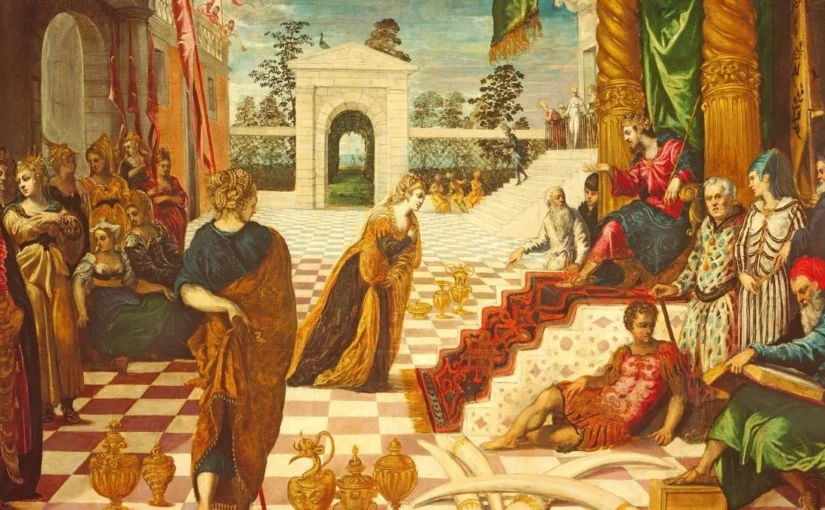
In subsequent centuries, balsam acquired the gravity of a state asset. The Queen of Sheba brought it to Solomon with her gold; Hezekiah, in a fit of imprudent pride, displayed his balsam oil to the Babylonian envoys, a vanity Isaiah would not forgive. Mark Antony, Josephus tells us, seized a Judean plantation outright to lay at Cleopatra’s feet, and during the Jewish War, Pliny records, Jewish fighters tried to destroy the plants altogether rather than let Rome inherit them. Herod, that sleepless architect, drew much of his wealth from the trade, financing the Second Temple, the cliff palaces of Masada, and the great harbor at Caesarea from the slow weeping of a few branches. Some scholars have even wondered whether the gold offered by the Magi was, in fact, afarsemon, a resin worth its weight in metal.
Galbanum and the Forbidden Recipe
In the elaborate liturgical chemistry of Exodus 30, galbanum makes its single, decisive appearance. A yellowish gum drawn from species of ferula, documented in Mesopotamian medicine as early as the third century before Christ, it possesses on its own a smell so sharp it borders on the unpleasant. Mixed into the sacred incense of the Temple, however, it performed the alchemical office of fixing and prolonging the other notes, holding frankincense and stacte in suspension as a base note holds a perfume. The recipe was hedged about with terrible prohibitions; to compound this incense for private pleasure was to die. The detail tells us much about how the ancient mind understood fragrance: as a code so potent that the wrong line, in the wrong hand, could constitute blasphemy.
Myrrh, the Bitter Gift
The word descends through Arabic mur and Hebrew mor, and both mean bitter. Myrrh is the resin of Commiphora myrrha, weeping in tears from incised bark, hardening into translucent nuggets that release, when burned, a smoke at once funereal and erotic. The Song of Songs sings of it lying between a lover’s breasts; Esther steeps in it for half a year before her audience with the king; the holy anointing oil cannot be compounded without it. In every register, sacred and sensual, myrrh marks the threshold between the body and what passes through the body.
The Magi who knelt before the child in Bethlehem placed myrrh among their gifts, and Christian commentators have read the gesture as a prophecy in resin, the foretelling of a passion to come. The prophecy was honored. On the way to Golgotha, Jesus was offered wine mingled with myrrh, the customary anodyne for the crucified, and he refused it. The same substance returned, in larger measure, with Nicodemus and the burial linens, so that the entire arc of the Gospels can be traced, if one wishes, by the path of a single fragrance.
The Myrtle Bride
The myrtle, by contrast, is a plant of joy. Its small, glossy leaves and white blossoms appear in the bouquet bound for the festival of Sukkot, waved toward the four quarters of the world in acknowledgment that the divine is not confined to any one of them. Brides wore wreaths of myrtle in ancient Judea, as their Greek sisters had done in honor of Aphrodite, and the gesture lingers, half-forgotten, in our wedding flowers still.
The prophets, ever alert to vegetation as moral allegory, saw in the myrtle a sign of restoration. Where thorns stand now, Isaiah promised, the myrtle shall come up; Zechariah’s first vision is set among myrtle trees in a deep valley, and the angel who speaks there speaks of peace. Esther, the Persian queen who saved her people, bore in her Hebrew name, Hadassah, the very word for myrtle, as if her courage were rooted in the shrub itself.
Nard, the Fragrant One
The Sanskrit nálada means the fragrant one, and Indian spikenard, Nardostachys jatamansi, has earned the epithet by traveling further on its scent than most plants travel on their roots. It came down from the Himalayan foothills along the trade routes that fed the Mediterranean, and it arrived in the Gospel of Mark in an alabaster jar that a woman in Bethany broke over the head of Jesus. The fragrance, the text insists, filled the house, and one feels the perfume diffusing not only through the room but through the centuries since. John places the gesture at the feet of the Master and gives the woman a name, Mary; the medieval imagination collapsed her with Magdalene, and an oil bearing that name is still sold in pious shops. The plant itself, harvested too eagerly from the wild, now faces extinction in its native ranges, the price of having been, for too long, simply the fragrant one.
The Olive, Patient Witness
Of all the trees of the Bible, the olive stands closest to the human story. The dove returning to the ark carries an olive leaf, and from that single image an entire iconography of peace has unfolded. The Mount of Olives shelters the prayers of Christ; the very word Christ, christos, means the anointed one, and the oil in question is olive oil pressed from the fruit of trees that may still be standing.
In the Garden of Gethsemane, certain gnarled specimens are old enough, by the patient counting of botanists, to have witnessed the night they commemorate. The Jewish proverb that one plants an olive tree for one’s grandchildren captures something that the modern impatience for results has nearly forgotten: that certain enterprises must be undertaken for a future one will not see. Older trees yield a resin with a faint vanilla sweetness that perfumers once added to incense, and the oil itself was the carrier of nearly every aromatic preparation in the ancient Levantine pharmacopoeia. So venerable was the tree that courts of justice were held under its shade and the tombs of the great were dug among its roots, until prophets, fearing idolatry, ordered some of the sacred groves cut down.
The Rose and the Cross
The rose comes late to the Bible, and when it appears in the deuterocanonical Sirach it stands among the rose bushes of Jericho as a figure of beauty. Its destiny lay elsewhere, in the elaborate symbology of Christian Europe, where the red rose came to signify the blood of Christ, the chalice of the Last Supper, the mystical rebirth promised by the resurrection. Crusaders carried roses home from Damascus, and the Gallic rose of Provins became the ancestor of nearly every modern variety, its dense purplish blossoms still recognizable in the cathedral windows of northern France. Persia had loved the flower first; Christendom gave it metaphysics.
Sage and the Lamp That Would Not Go Out
Sage in Hebrew is marwa, but a Cretan variety has long been known in Israel as moriya, a name that may be translated, with a kind of pious looseness, as the scent of God. The plant is tied, in folk memory, to the festival of Hanukkah and to the older history of the seven-branched menorah, that lamp whose image stands carved on the Arch of Titus in Rome as a trophy of empire. When the Maccabees recovered the desecrated Temple, the legend of the cruse of oil that burned eight days instead of one was born, and the nine-branched hanukkiah, eight lights for the miracle and a ninth servant, came into being. The oil that burned was, of course, olive; the plant of memory that surrounds the story is sage, and the conjunction is fitting, since both belong to the slow, fragrant tenacity of Mediterranean hillsides.
Frankincense, the Smoke of Prayer
Levonah in Hebrew, libanos in Greek, frankincense is the tear of Boswellia sacra, a small tree of austere appearance that thrives in the driest corners of Arabia, Africa, and the Indian subcontinent. The white resin is rarer and bitterer; the yellow variety, more abundant, perfumes the censers of Catholic and Coptic liturgy to this day. Its rising smoke is read, almost universally, as the visible form of prayer, and its scent as a barrier against the unclean. In the Jerusalem Temple, the priests offered incense daily; in the temples of Baal at Babylon, by ancient report, as much as twenty tons of frankincense burned in a year. The Roman state, growing imperial, came to substitute incense for blood sacrifice, and demanded of its citizens those small offerings to the divinized emperor that early Christians refused to make, paying for the refusal with their lives.
The resin was traded for gold along the Frankincense Road, a network stretching thousands of kilometers from southern Arabia northward, and the expedition that Queen Hatshepsut sent to the land of Punt around 1490 BC is recorded in vivid bas-relief on the walls of her mortuary temple at Deir el-Bahri, where the incense trees stand in their pots, transplanted at imperial command. The Magi who brought frankincense to Bethlehem were participating, without knowing it, in a commerce already two millennia old.
Hyssop, the Humble
Of all the herbs of the Bible, hyssop is the most modest. It grows in stony crevices, scarcely more than a wildflower, and its slim fronds were used to sprinkle blood and consecrated water in the rituals of purification. In the monastery gardens of medieval Europe, hyssop earned its keep against coughs and bees and eventually crept into the famously secret recipe of Chartreuse. The painters of the late Middle Ages placed it in the hand of the Virgin as an emblem of humility. And in the harrowing scene of John 19, when a sponge soaked in vinegar is raised to the lips of the dying Christ, the stalk that lifts it is hyssop, the smallest of plants chosen to fulfill an ancient prophecy. The choice is so improbable that it must be deliberate.
The Cedar of Lebanon
If hyssop stands for humility, the cedar stands, in nearly every biblical passage that mentions it, for grandeur. Cedrus libani rises sixty feet and lives for centuries; its dense, fragrant wood resists rot, vermin, and time. Egypt cut cedar for the coffins of its pharaohs and varnished both coffin and mummy with a resin distilled from its needles. Solomon imported it from Hiram of Tyre, floating the trunks south as rafts along the coast to Jaffa and from there inland to Jerusalem, where they framed the Temple. Alexander built his fleet from cedar. Ezekiel saw in it the figure of imperial pride and predicted its fall.
The forests that once covered Lebanon and the Cilician Taurus have been reduced, by three thousand years of harvesting, to scattered groves, and what remains is preserved by enclosure and reverence. The cedar still stands at the center of the Lebanese flag, a botanical sovereign in a country much disturbed, and the felling of one is still spoken of, in some traditional villages, as an evil omen. The medieval imagination associated the cedar with the Virgin Mary, drawn perhaps by its scent and its imperviousness to decay; in pre-Christian centuries it had been simply, and accurately, the tree of God.
Cistus, the Resin of the Wanderer
The story of Joseph that opened with balsam closes, almost, with ladanum. The Ishmaelite caravan that descends from Gilead carries among its loads a dark, fragrant resin secreted by the hairy leaves of Cistus incanus, the rockrose of the Mediterranean macchia. In Spain, in southern France, in the dry hills of Istria, the cistus still spreads its low gray-white carpet, and in spring it covers itself with large papery flowers of white and rose. The shepherds of antiquity gathered its resin by combing the wool of goats that had grazed among the bushes, an image so pastoral it seems invented. Joseph’s brothers, years later, on the eve of their fateful return to Egypt, are instructed by their father to take among their gifts a little balm and a little honey, gum and ladanum, almonds and pistachios. The list is the inventory of a vanished world, and the rockrose, blooming still on Mediterranean cliffs, is its last surviving witness.
What lingers, when one closes the long catalogue of these plants, is less a botanical inventory than a sense of how thickly the spiritual life of the ancient world was scented. Prayer rose in smoke, kings were anointed with oil, the dead were wrapped in resin, brides were crowned with myrtle, prophets pointed to the cedar and the myrtle as the very signature of God. We have largely lost this olfactory grammar. Our liturgies, when they survive, retain a faint trace of it, and our perfumes a fainter one still. But the plants themselves continue their patient work on the hills above the Jordan and the dry slopes of Arabia, indifferent to the empires that have come and gone for their sake, exhaling, as they have always done, the slow vocabulary of the sacred.
Header: Tintoretto – The Visit of the Queen of Sheba to Solomon.