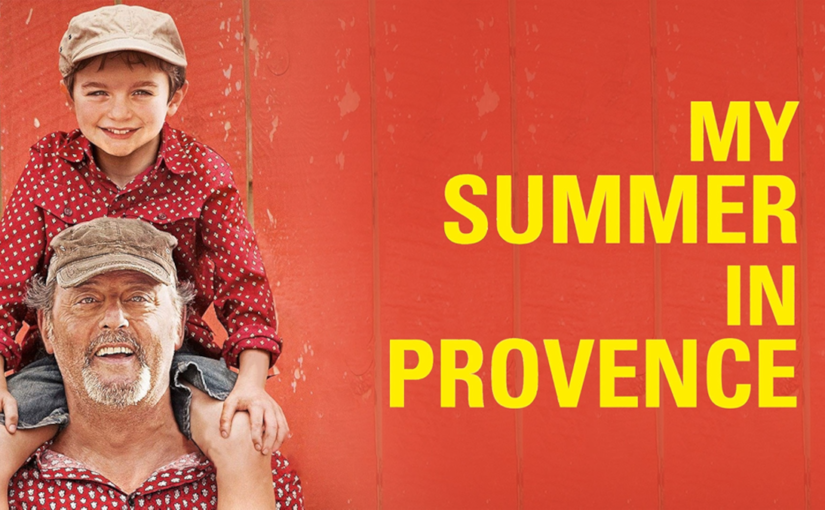
There are films one watches, and there are films one inhabits. Rose Bosch’s Avis de mistral, released in 2013 under the rather more touristic English title My Summer in Provence, belongs unmistakably to the second category. It is a modest work, ostensibly a family drama, that nevertheless allows itself the luxury of being primarily a landscape, and only secondarily a plot. The story serves the country, not the other way around, and this inversion is the source of whatever quiet enchantment the film achieves.
The premise carries the comforting symmetry of a fable. Three Parisian children, Léa, Adrien, and their younger brother Théo, who is deaf, are dispatched southward after their parents’ marriage begins its slow collapse. They are deposited, somewhat unceremoniously, in the care of a grandfather they have never met: Paul Mazuret, an olive farmer carved from the same sun-bleached stone as his hillside, played by Jean Reno with the bruised gravitas the role demands. A family quarrel, ancient and unhealed, has kept them strangers. Now a summer in the Alpilles will be asked to undo what decades of silence have hardened.
The collisions that follow are predictable in their outlines and surprising in their grace. The children arrive trailing the wires and screens of their generation; Paul greets them with the suspicion of a man whose vocabulary has been pared down by weather and solitude. There are skirmishes, sulks, and the small humiliations that pass between adolescents and the elderly when each suspects the other of having stolen the world. Yet Bosch is too patient a director to force her reconciliations. They arrive obliquely, in the rhythm of harvests and shared meals, in the gradual recognition that Paul’s gruffness conceals a 1970s romanticism, lovingly seconded by Anna Galiena as his wife, the residue of a counter-culture that once believed land and labor might save a person.
What lingers, though, is the country itself. Bosch filmed across the Bouches-du-Rhône with the air of someone settling old debts of affection. Saint-Rémy-de-Provence, with its Roman bones and its labyrinth of pale lanes, offers its rustic dignity. Saintes-Maries-de-la-Mer contributes the strange luminous flatness of the Camargue, where white horses and flamingos move through a light that seems borrowed from another century. Eygalières yields its olive groves; Les Paluds de Noves its stone farmhouses; Mouriès, perhaps most importantly, lends its orchards to Paul’s fictional domain, so that the grandfather and his land become indistinguishable, two weathered surfaces sharing a single soul.
Above all there are the Alpilles, that modest limestone range which the film returns to with the devotion of a pilgrim. Cézanne would have understood the impulse. The hills are not picturesque so much as inevitable, their golden ridges presiding over the action like an older, wiser cast. Mist gathers in the olive trees at dawn. Cicadas conduct their interminable orchestra. The mistral, that ill-tempered northern wind which gives the film its proper title, sweeps through and rearranges moods as easily as it rearranges shutters. One begins to suspect that the wind is the true protagonist, and the humans merely its temporary subjects.
Bosch’s camera lingers, sometimes shamelessly, on the iconography of the region: lavender turning the middle distance violet, sunflowers nodding like a parliament of yellow heads, market squares thick with conversation, courtyards where the heat pools beneath plane trees. The cinematography occasionally risks postcard, but it earns its indulgence because the film understands that the children’s transformation depends on saturation, on being slowly steeped in a sensory world they did not know they were missing. Without Wi-Fi, without the consoling alibi of constant connection, they are forced into the older intimacies: a river hidden behind reeds, fruit picked and eaten in the same minute, the slow democracy of an olive harvest in which everyone’s hands end up stained the same green.
Here the film stakes its quiet claim. Provence has long been the favored hallucination of northern Europe, a place onto which Van Gogh, Cézanne, Pagnol, and a thousand lesser pens have projected their longings for a life lived in accordance with weather rather than schedule. Bosch knows this myth perfectly well and chooses neither to debunk it nor to inflate it. She simply lets it work. The land does what the screenplay cannot, and the screenplay has the wisdom to step aside.
It would be ungenerous to pretend the narrative is original. The urban-rural divide, the thawing patriarch, the children rediscovering the texture of unmediated hours: these are well-worn instruments, and Bosch plays them in their familiar keys. Critics noted as much when the film appeared, and they were not wrong. What they perhaps underestimated is the legitimacy of comfort as an artistic ambition. Not every film must rupture or provoke. Some are content to remind us that light falls a certain way on stone in late August, and that this fact, properly attended to, can be a form of consolation.
By the closing scenes, when the sky over the Alpilles performs its nightly conversion to orange and rose, the film has earned its sentimentality, if sentimentality is even the word. Something closer to gratitude, perhaps. The children will return to Paris altered in ways they will not be able to articulate for years. The grandfather will return to his trees. The wind will continue its arguments with the cypresses. And the viewer, briefly granted a tenancy in this stubborn, sunlit corner of France, will close the film with the peculiar sensation of having been somewhere, rather than merely having watched something. In an age that increasingly confuses the two, that is no small accomplishment.
Beyond the Screen: Visiting the Real Provence
The locations Bosch chose were not invented for the camera, and they do not vanish when the credits roll. They continue their long, indifferent existence in the Bouches-du-Rhône, accumulating summers as they have for centuries, and the curious traveler who follows the film’s itinerary will find them undiminished, perhaps even slightly amused at the attention.
Saint-Rémy-de-Provence remains the most layered of these places, a town that wears its Roman past with the casualness of a family heirloom too familiar to be displayed. Glanum lies just outside the walls, its arches and foundations baking quietly in the same light that, a few centuries later, undid Van Gogh’s composure at the nearby asylum of Saint-Paul-de-Mausole. The streets themselves, narrow and shuttered against the afternoon, suggest that the town has long since negotiated a treaty with the heat.
Saintes-Maries-de-la-Mer, further south, belongs to a different Provence altogether. The Camargue dissolves the firm geometries of the interior into salt marsh and horizon, and the village itself carries the weight of older devotions: the annual pilgrimage of the Roma to Sara la Kali, the fortified church rising from the flat land like a ship at anchor, the white horses moving through water as though they had forgotten the distinction between elements. The Mediterranean here is not the polished blue of the Côte d’Azur but something wilder, more reflective, less interested in being admired.
Eygalières offers the Provence of imagination almost too readily. Olive groves stitch the slopes, stone houses lean companionably against one another, and the view from the ruined chapel of Saint-Sixte arranges itself with the calm assurance of a landscape that has been painted many times and expects to be painted again. Les Paluds de Noves, by contrast, keeps its pleasures to itself. It is the kind of small commune where one understands, finally, why the French invented the verb flâner, and why they have resisted translating it.
Mouriès, the spiritual center of Paul’s fictional farm, is also the literal center of French olive production, a town whose calendar still bends around the harvest and the pressing. Its markets dispense the slow vocabulary of the region: tapenade, fougasse, the green oil that tastes faintly of cut grass and pepper. To stand in its square on a market morning is to understand that what the film stylized was not invented but observed.
These places do not require the film to justify them, and the film, to its credit, never pretended otherwise. What Bosch borrowed, the country still possesses: the alliance of stone and sunlight, the patience of olive trees, the sense that time in Provence does not so much pass as accumulate, settling like fine dust on everything it touches.