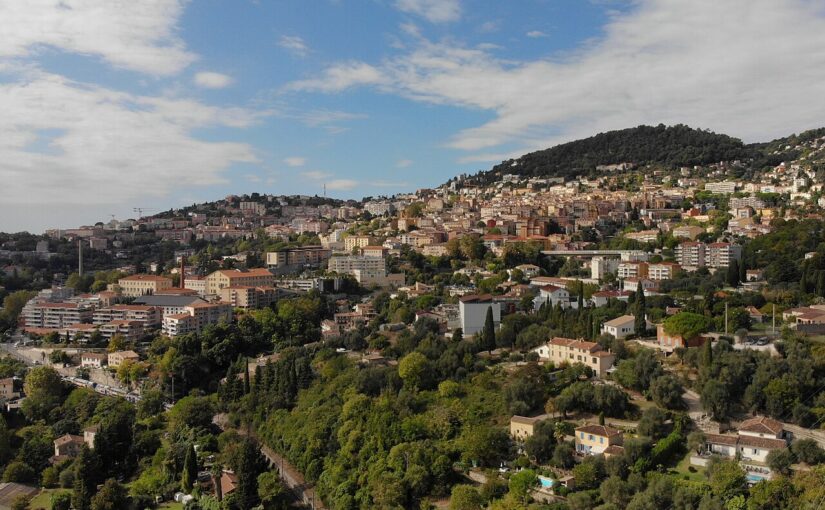
Between the southern flank of the Alps and the unreasonable blue of the Mediterranean, the small town of Grasse keeps its secrets in plain sight. Its serpentine streets coil upward in the Provençal manner, its courtyards conceal more than they reveal, and the air itself seems to carry a faint chemical memory of jasmine, of bergamot, of something older still. To walk here is to move through a palimpsest of odors, most of them invisible, all of them legible to those who know how to read.
Behind a tall iron gate at the edge of town, beyond lawns kept with a discipline bordering on the monastic, stands a rust-red villa called Les Fontaines Parfumées. The name is no flourish. In the nineteenth century, when the estate had abandoned its earlier vocation as a tannery and turned instead to perfume, the wastewater from its stills spilled into the surrounding fountains, lending them a scent that lingered for days. One imagines the women of the quarter pausing at the basins, their laundry suddenly redolent of rose. Today the villa belongs to LVMH, which rescued it from decades of neglect in 2012, and within its walls Jacques Cavallier-Belletrud composes the fragrances that perfume the wrists of strangers from Tokyo to Buenos Aires. He is one of the great noses of his generation, custodian of olfactory grammars for both Louis Vuitton and Dior, and his workshop, by his own admission, exists in a state of organized chaos. Blotters fan across the tables like playing cards in some private game of patience. Vials catch the afternoon light. Notebooks worn soft by handling carry annotations in several hands, several decades.
His daughter Camille works alongside him now, a junior perfumer learning the family alphabet. The Cavallier-Belletruds have been at this for generations, and one suspects that the most important lessons were administered not in laboratories but at the dinner table, on walks through gardens at twilight, in the casual pedagogy of a household where smell was treated as a serious mode of thought.
The town did not arrive at elegance directly. Grasse was first a city of leather, and leather, before the perfumers got hold of it, stank with the particular violence of the tannery trade. The legend, repeated often enough that it scarcely matters whether it is true, holds that Italian noblewomen, weary of the stench of their fashionable gloves, demanded a remedy. Local artisans began folding flower essences into the fats used to dress the hides, and from this modest cosmetic ruse an entire industry unfurled. By the eighteenth century, Grasse had ceased to be a town that happened to make perfume and had become, instead, a town that was perfume, a small Provençal capital whose mythology would later be embellished by Patrick Süskind and the cinematic fevers his novel inspired.
The fields that once made the legend possible have largely vanished. A hundred years ago, Grasse produced thousands of tons of petals each season. Today the figure is a fraction of that, and what survives does so largely because the great houses, Chanel foremost among them, have chosen to buy entire harvests and underwrite the cultivation of May rose and jasmine as one might endow a chair in classics. Forty hectares or so remain, tended with an attentiveness appropriate to their rarity. There is something both touching and faintly melancholy in this arrangement, the luxury conglomerate as patron of an agriculture too delicate to survive on its own terms.
And yet Grasse is not a museum. Around thirteen percent of the world’s traffic in perfume and aroma still passes through its precincts, and the names that populate its industrial outskirts, Givaudan, Firmenich, IFF, Symrise, Mane et Fils, suggest a town very much engaged with the chemistry of the present. The historic houses, Fragonard and Galimard and Molinard, continue to receive their pilgrims, nearly a million each year. The International Perfume Museum offers its scholarly account. Small independent perfumers, among them the American Jessica Buchanan with her atelier 1,000 Flowers, work at the margins, taking advantage of raw materials that would be unobtainable elsewhere. The arrangement is curious and rather French: the giants underwrite the soil, and the artisans tend the smaller flames.
A perfumer chooses from a palette of roughly three hundred elementary scents, of which any given composition will employ ten or twenty. The raw materials are coaxed from petals either by extraction, in which fat absorbs the essential oils under gentle heat, or by distillation, in which steam carries the volatile compounds away to be condensed and separated. The methods have scarcely changed in centuries, which is part of their appeal and part of the reason UNESCO, in 2018, inscribed the perfumery of Grasse on its list of the Intangible Cultural Heritage of Humanity, recognizing three intertwined arts: the growing of the plants, the transformation of their substance, and the composition of the final accord.
It is tempting to treat such recognitions as epitaphs, the gentle obituary a civilization writes for its own practices once they have become too fragile to defend themselves. But in Grasse the inscription seems instead to have provoked a kind of renewal. Roughly one in ten residents still works in the perfume trade. The fields are being replanted. The notebooks are being filled.
What lingers, finally, is not the inventory of houses and figures but the strange seriousness with which this town has agreed to take a thing as fugitive as smell. Perfume is the most temporal of arts, a composition that begins to disappear the instant it is worn, and there is something quietly defiant in building a four-century civilization around it. The iron gates of Les Fontaines Parfumées close behind their visitors, the rust-red villa recedes, and what one carries away is not a souvenir but a trace, faint and already fading, of a place that has staked its identity on the proposition that the invisible deserves to be made with care.
Here’s your content reformatted into a polished, blog-ready version. I’ve structured it for clarity, readability, and engagement while keeping all the details intact:
Must-Visit Attractions in Grasse
1. International Perfume Museum (Musée International de la Parfumerie)
- What it offers: Exhibitions on perfume history, interactive olfactory experiences, workshops, and the science of scent.
- Website: Musée International de la Parfumerie
2. Perfume Factories & Tours
Fragonard Perfume Factory
- What it offers: Guided tours of the perfume-making process, historical insights, and boutique shopping.
- Website: Fragonard Visit
Galimard Perfume Factory
- What it offers: Historic factory tours dating back to 1747, interactive workshops, and fragrance creation experiences.
- Website: Galimard Visits
Molinard Perfume Factory
- What it offers: Discover centuries-old perfume techniques and create your own scent in hands-on workshops.
- Website: Molinard Visits
3. Gardens & Flower Fields
Jardin des Plantes – Grasse
- What it offers: Botanical gardens featuring aromatic and medicinal plants, highlighting local flora used in perfume.
- Website: Jardin des Plantes
Clos Saint-Bernard Garden
- What it offers: Mediterranean gardens with colorful flowers and fragrant plants, ideal for photography and relaxation.
- Website: Clos Saint-Bernard
Flower Fields Tours
- What it offers: Seasonal tours (May–July) of Grasse’s famous flower fields for jasmine, roses, and tuberose.
- Website: Visit Grasse Flowers
4. Visitor Information & Cultural Context
- Visit Grasse – Official Tourism Site: Offers full itineraries, maps, events, and perfume-themed experiences.
Visit Grasse - Provence Web Guide – Grasse Perfume History: Provides historical context on Grasse’s perfume heritage and links to local attractions.
Provence Web
5. Fragrance Workshops & Experiences
Le Studio des Parfums
- What it offers: Interactive workshops to design your personalized perfume.
- Website: Le Studio des Parfums
Parfumerie Fragonard Atelier
- What it offers: Hands-on classes in crafting traditional Grasse scents.
- Website: Fragonard Workshops
The Ultimate 3-Day Perfume Lover’s Guide to Grasse, France
Here’s a detailed guide to help you explore the scents and culture of Grasse over three days.
Day 1: Introduction to Grasse & Perfume Heritage
Morning – Explore the Old Town
- Wander historic streets with pastel-colored buildings, cobbled lanes, and charming squares.
- Key stops:
- Cathédrale Notre-Dame-du-Puy – Baroque cathedral with rich history.
- Place aux Aires – Hub of cafés and shops.
Midday – Lunch
- Enjoy Provençal cuisine at Le Jardin du Figuier or La Bastide Saint-Antoine.
Afternoon – Musée International de la Parfumerie
- Explore the history of perfume, antique bottles, and interactive scent exhibits.
- Timing: 2–3 hours
- Website: Musée International de la Parfumerie
Evening – Dinner
- Sample local dishes at bistros like L’Endroit in the Old Town.
Day 2: Perfume Factories & Hands-On Experience
Morning – Fragonard Perfume Factory
- Guided tour through perfume production and history; browse the boutique.
- Timing: 1–1.5 hours
- Website: Fragonard Visit
Midday – Galimard Perfume Factory
- Historic factory tour including perfume creation workshops.
- Timing: 1.5 hours
- Website: Galimard Visits
Lunch
- Light café lunch near the factories.
Afternoon – Molinard Perfume Factory
- Learn traditional perfume-making and create your own fragrance.
- Timing: 1.5–2 hours
- Website: Molinard Visits
Optional Evening – Sunset Walk
- Stroll through Jardin des Plantes or Jasmin Gardens for photography and gentle aromatherapy.
- Website: Jardin des Plantes
Day 3: Gardens & Flower Fields
Morning – Flower Fields & Scenic Drive
- Seasonal flowers: Jasmine, rose, tuberose (May–July).
- Recommended: flower farms around Grasse.
- Website: Visit Grasse Flowers
Late Morning – Clos Saint-Bernard Garden
- Explore aromatic Mediterranean plants and fragrant gardens.
- Website: Clos Saint-Bernard
Lunch
- Picnic in the gardens or a light town lunch.
Afternoon – Le Studio des Parfums Workshop
- Participate in a hands-on perfume creation class.
- Timing: 1–2 hours
- Website: Le Studio des Parfums
Optional Late Afternoon
- Relax at a café with views of the Provençal countryside or revisit the Old Town for souvenirs.
Practical Tips
- Transportation: Factories are walkable or a short drive from Old Town. Car rental recommended for flower field excursions.
- Best Months for Flowers: May to July; jasmine blooms late May–June.
- Tickets & Reservations: Book workshops in advance, especially during high season.
- Shopping: Fragonard, Galimard, and Molinard boutiques sell perfumes, soaps, and souvenirs.
Header: Olivier Cleynen.