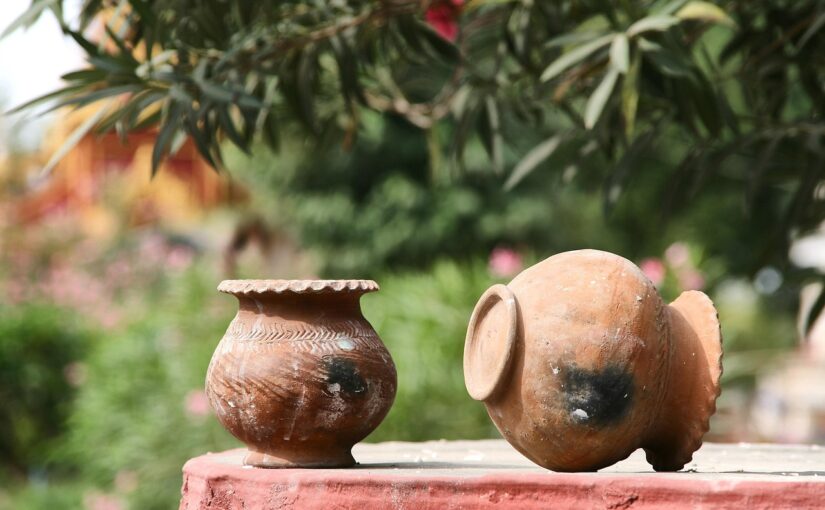
There are landscapes one recognizes before ever having seen them, and the Mediterranean is foremost among these. It announces itself in a color before it announces itself in a place. The traveler descending toward Liguria, or stepping off a ferry at Naxos, or rounding a bend in the Atlas foothills, encounters the same chromatic confession: a russet, a burnt amber, a dusty rose that seems to have been pressed out of the soil by centuries of sunlight. In the cradle of ancient civilizations, where the sun hangs heavy and the earth yields its secrets, color emerges not merely as pigment but as a living pulse. Terracotta and ochre, those warm tones drawn from the soil itself, have long whispered the story of the Mediterranean.
The vocabulary is telling. The word itself, terracotta, comes from the Italian for “baked earth,” a phrase so direct it borders on the sacramental. Here is a civilization naming its houses after the ground that holds them. Long before architects sketched blueprints, the peoples of these shores turned to what lay beneath their feet: clay, abundant and malleable, fired in the relentless sun or in modest kilns. Ochre, that softer spectrum of yellows and reds, was drawn from iron-rich deposits, ground into powders, mixed with lime to compose walls that endured the elements. The chemistry is mundane. The result is not.
One is tempted to read these colors as decoration, but that would be to mistake the surface for the substance. The Mediterranean climate, with its scorching summers and mild winters, demanded materials that breathed; terracotta tiles absorbed the day’s heat and released it slowly into the night, cooling interiors without imposing the chill of stone. Practicality, then, was the first conversation. The poetry came later, or rather, came at the same time and was simply slower to be noticed. In Crete, the Minoans painted their palaces with frescoes in ochre tones, depicting bull-leaping youths against sunlit backdrops, as if the earth itself were celebrating vitality. These colors did not merely adorn; they invoked the gods of harvest and hearth, binding human dwellings to the divine landscape.
Cross the water southward and the same pigment speaks in a different accent. Among the Berber communities of Morocco and Algeria, terracotta was interpreted through the lens of nomadic endurance. Ochre walls of kasbahs rose like sentinels in the desert, their dusty reds blending into the Saharan sands, the color itself a symbol of resilience, a visual anchor for those who wandered but always returned to the idea of home. The kasbah at Aït Benhaddou is the archetype: a fortress that does not so much rise from the earth as continue it, the architecture refusing to declare where the ground ends and the wall begins. This is, perhaps, the deepest grammar of Mediterranean building. The house is not placed upon the land. It is the land, slightly rearranged.
Provence offers the same idea translated into a softer dialect. Imagine the play of light on a farmhouse at dawn: the ochre facade catches the first rays, glowing like embers in a fading fire, while terracotta shutters frame windows that overlook lavender fields. The colors owe their endurance to the mistral and the dry heat that bakes the earth into a palette of russets and ambers, while builders slaked lime with ochre from local quarries, creating washes that aged gracefully, their patinas deepening like memories etched in stone. One thinks of Roussillon, where the cliffs themselves resemble a crushed sunset, and where the village seems to have agreed, long ago, to wear the colors of its own geology.
In Andalusia, the register shifts again, and the temperature rises. The whitewashed pueblos of the south perch on cliffs, but their terracotta accents in doorways and patios pulse with the intensity of flamenco rhythms. Ochre is drawn from the mineral veins of the Sierra Nevada, mixed into plasters that recall the region’s Moorish legacy, where Islamic artisans infused these hues with geometric precision, interlocking tiles in terracotta reds suggesting the infinite patterns of fate and faith. The Iberian sun, fiercer than its northern cousin, demanded a strategy of absorption rather than reflection, and the result is an architecture that breathes warmth even while offering shade. Walls curve like a lover’s form, enclosing courtyards that blur indoors and out, home and horizon.
Greece gives the palette a more austere reading. The Cyclades have been so thoroughly photographed in their whites and blues that one forgets the ochre underneath, the older voice. On Santorini, blue-domed churches rise from volcanic cliffs, but their terracotta bases and pathways recall the island’s pumice soils, fired by ancient eruptions into resilient forms. The Greeks revered these colors in their temples; the Parthenon’s marbles, once painted in vivid ochres, stood as tributes to Athena. The whitewashed Greece of the postcard is a relatively recent invention. The deeper Greece, the Homeric one, was the color of the kiln. Home, or oikos, was sacred, a microcosm of the cosmos, and terracotta urns and roof tiles, ubiquitous in the epics, carried the dead to the afterlife while cradling the living in their daily routines.
Italy, of course, is where this whole grammar reaches its operatic register. Tuscany’s cypress-lined roads lead to villas where ochre walls embrace vineyards, their tones harvested from the clay beds of the Chianti earth, and the Renaissance masters drew inspiration from Etruscan roots, where terracotta plaques had once adorned tombs with scenes of feasting and farewell. There is something almost indecent about the way an Umbrian afternoon collaborates with these walls, the light insisting on every faded patch and water stain as though each were a brushstroke worth preserving. For Italians, these colors carry heritage as a visual lineage running from Roman aqueducts to medieval hill towns, where every faded wall whispers of ancestors who tilled the same soil.
And then there is Tunisia, where the palette acquires a different pungency. In the medinas, terracotta mingles with turquoise doors, ochre dominating the labyrinthine alleys, drawn from the red sands of the Atlas. Berber and Arab influences blend, with colors signifying protection against the evil eye, while the harsh sun and the sirocco demand thick earthen walls that cool by evaporation. Home becomes a fortress of memory, with terracotta’s warmth combating isolation, drawing families into riads centered on courtyards alive with fountains and figs. The architecture is introverted, turned away from the street and toward an inner garden, the way certain people are reserved in public and lavishly tender at home.
What unites these dialects, what makes them legible as a single conversation despite their geographic distance, is something more than shared geology. It is a philosophy of dwelling. The interplay of climate, materials, and the human yearning for rootedness produced an architecture in which the sun, ever-present, bleached stones pale yet enriched clays with fiery depth, compelling builders to harness these tones for harmony, using straw-tempered clay or lime-ochre plasters that were local, sustainable, born of the land’s own generosity. Each region inflects the same proposition. Provence’s gentle ochres speak of pastoral idyll; Spain’s bolder reds pulse with fiesta energy; Greece’s subtler tones carry philosophical calm; Italy’s, operatic drama; North Africa’s, resilient mystery. Each variation reflects how a people perceived its place in the world: terracotta as the earth’s gift, ochre as captured sunlight.
It is fashionable, in our present epoch of glass facades and brushed steel, to treat these warm-walled villages as picturesque relics, suitable for holiday and Instagram but somewhat embarrassing to take seriously as architecture. This is a misjudgment. Terracotta and ochre are not nostalgia. They are an argument, made in pigment, about what a building is for. They insist that shelter is also remembrance, that a wall can be a form of continuity, that the color of a house should answer to the color of the ground it stands on. In a fast world of glass and steel, these colors call us back to memory’s hearth, where home is the warmth of heritage etched in every hue, and where true architecture cradles the spirit, turning mere walls into whispers of the sun-soaked soul.
To stand at sunset before an old wall in Sienna, or Chefchaouen’s lower terraces, or a half-ruined farmhouse in the Mani, is to understand that these pigments have outlasted empires precisely because they were never imperial. They were domestic, modest, drawn from the nearest hillside. They are what remains when ambition has finished its work and gone home. The Mediterranean has always known this. The rest of us are slowly remembering.
Major Museums with Significant Terracotta Collections
- National Archaeological Museum (Naples, Italy): Renowned for its extensive collection of Greco-Roman antiquities, including large-scale terracotta figures and Pompeiian artifacts.
- Museo Nazionale Etrusco di Villa Giulia (Rome, Italy): The premier museum for Etruscan art, housing crucial terracotta votives, sarcophagi, and architectural decorations.
- National Archaeological Museum (Athens, Greece): Contains a massive collection of ancient Greek ceramic art, including terracotta figurines and vessels from various periods.
- Museum of Cycladic Art (Athens, Greece): Focuses on Aegean and Cypriot cultures, with significant holdings of early clay figurines.
- Terracotta – Ceramics Documentation Center (Oristano, Italy): Located in the “City of Ceramics,” this center documents Mediterranean traditions from the Neolithic period onward.
- Museu Nacional d’Art de Catalunya (Barcelona, Spain): Features collections spanning Mediterranean art, including specialized ceramic, pottery, and Romanesque to modern, often incorporating traditional clay mediums.
Specialized & Archaeological Collections
- Archaeological Museum of Kerameikos (Athens, Greece): Located at the site of the ancient potter’s quarter, it holds crucial finds of Athenian terracotta production.
- Archaeological Museum of Piraeus (Piraeus, Greece): Known for its collection of votive reliefs and large terracotta statues.
- Mercati di Traiano – Museo dei Fori Imperiali (Rome, Italy): Displays architectural terracotta and finds from the heart of the Roman Empire.
- Directorate of Archaeological Museums, Exhibitions and Educational Programs (Greece): Official directory listing Greek museums with significant terracotta collections.