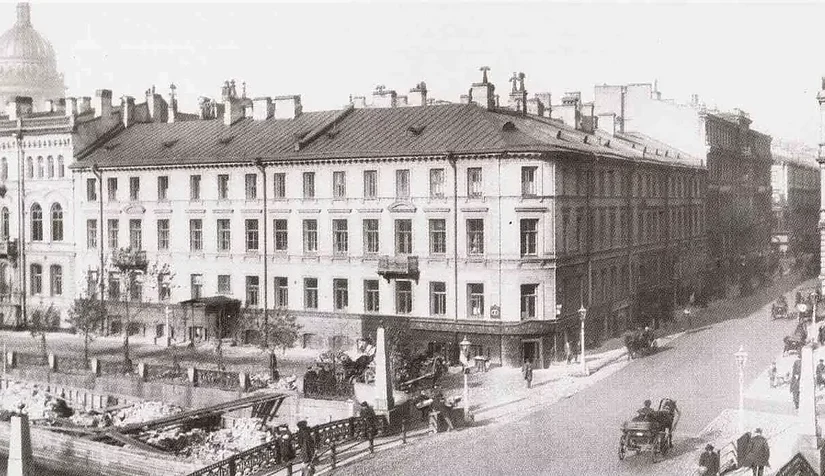
Every so often, in the salons and ateliers of old Europe, a particular species of zealot makes his appearance: the convert who cannot let a meal pass without a homily, who turns the simplest encounter into a small theological occasion, and who, by careful degrees, makes himself magnificently impossible to seat beside anyone at dinner. Paolo Troubetzkoy was such a man. In the spring of 1909, in a half-empty banquet hall on the Moika, he rose before twenty bewildered guests and delivered a sermon that began with his love of life and ended with a warning about disease, while the meat courses cooled and curdled in front of them.
He had reasons, that year, to feel triumphant. Italian on his father’s side, Russian on his mother’s, he had spent his life crossing borders the way other men cross drawing rooms, and he had just given Saint Petersburg an equestrian monument to Alexander III which the painter Repin venerated as a masterpiece and which the court regarded as something close to lèse-majesté. The bronze tsar squatted on a bronze horse with an animal heaviness no court sculptor would have permitted himself. Repin worshipped it. The Romanovs muttered about caricature. The radicals smiled into their collars. Only the Dowager Empress, recognising in that brutal silhouette the husband she had loved, refused to let it be touched.
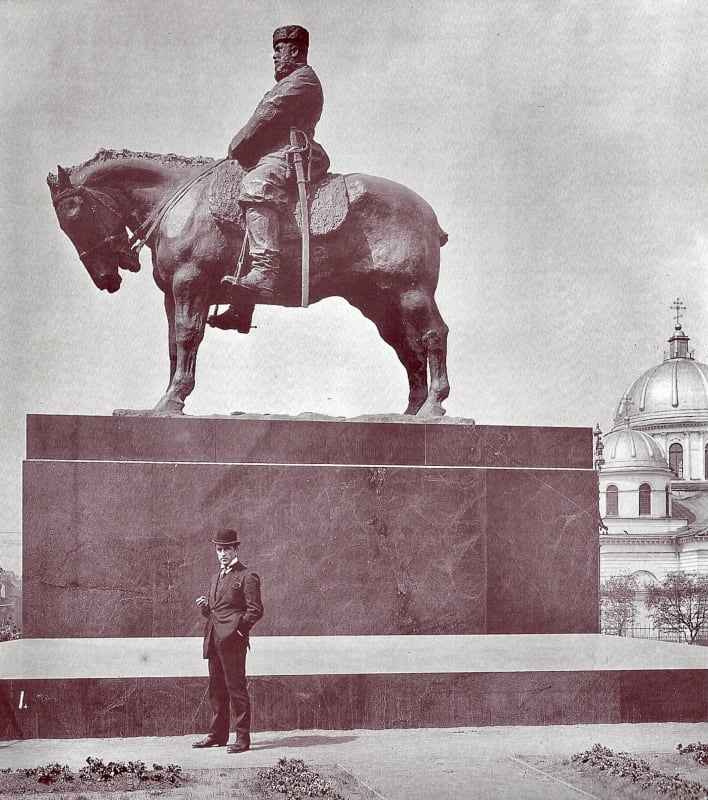
There exists, in some archive, a photograph of the sculptor standing beside the colossus. He looks small next to the beast he has made. The horse is monstrous, the tsar squat and immovable, and the whole composition seems to press downward into the granite, as if the empire itself were sinking under its own weight. I do not engage in politics, Troubetzkoy is supposed to have said. I simply portrayed one animal upon another. The line has been read ever since as a sly joke at the expense of Alexander. Whether he meant it so, no one quite knows.
What is less remembered is that the same hands which moulded that stubborn bronze tsar were given, in restaurants, to the curious habit of accosting head waiters. Sniffing his soup with the theatrical horror of a man who has just unmasked a crime, Troubetzkoy would inquire, with wounded astonishment, whether what swam in the tureen was in fact a corpse. Un cadavre? Dans la soupe? One imagines the silence afterwards. The waiter’s polite shock. A fork suspended mid-air. The actress beside him, Lydia Yavorskaya, with her stage-trained presence, deciding in that very instant to convert. The flowers on the table suddenly looking less like decoration and more like an alibi.
The preaching is what interests the historian.
It was, of course, Tolstoy’s fault. In the late 1880s the count had walked through a slaughterhouse near Tula and emerged with the conviction that no moral life could be built upon what he had seen there. As long as there are slaughterhouses, there will be battlefields. From that single scalding sentence the Russian vegetarian movement traced its lineage. The first Russian Vegetarian Society was founded in Petersburg in 1901. By the year of Troubetzkoy’s scandal, modest canteens without flesh on the menu had begun to appear along the Nevsky, and the Society’s journal, Vegetarianskoe Obozrenie, debated questions of ethics, nutrition and pacifism with a seriousness elsewhere reserved for theology. Four years later, the city would host an International Vegetarian Congress with five hundred delegates. None of it, in the Russia of pelmeni and beef stroganoff, was inevitable. It was the work of conviction.
Troubetzkoy met Tolstoy at Yasnaya Polyana in 1898 and modelled his bust the following year. What he carried away from that visit was not merely a regimen but a manner: the willingness to be tedious in the name of truth, to make oneself the unwelcome conscience of every gathering. Tolstoy proselytised on a continental scale. Troubetzkoy, being a sculptor and not a novelist, did the work room by room, cabby by cabby, shopkeeper by shopkeeper. In Paris, he confessed once at a breakfast table, with that boyish, sunburned smile, no one invites me to dinner anymore. I have made myself insufferable with my sermons. The line is delivered without contrition. He has clearly decided that being insufferable is, in this matter, a kind of honour.
His own account of the campaign has the tempo of a comedy and the conviction of a creed. A cab driver picks him up; he asks immediately whether the fellow eats corpses, and the conversation goes from there. His wife, he admits, is exhausted by hearing the same arguments a thousand times over. He once entered a furniture shop, fell into a sermon, forgot what he had come to buy; the shopkeeper forgot also. They ended up in the garden eating fruit. The man became, he says with satisfaction, a disciple. Then there was the wealthy American cattle dealer commissioned to sit for a portrait bust. The first sitting passed in silence. During the second, between strokes of the modelling tool, Troubetzkoy looked up and asked, almost casually, whether the man was happy. Whether his conscience was clear. And that, the sculptor concludes with evident satisfaction, was the beginning.
He belonged to that peculiar Russian generation for whom an aesthetic conviction and a moral one were never separable items on a list. Tolstoy in The First Step had written that the slaughterhouse was the foundation stone of every other cruelty, and Troubetzkoy, with the unembarrassed literalism of a sculptor accustomed to pressing his thumb into soft material, simply began rearranging the world to match.
From a comfortable distance of a century, one may find all this faintly quaint. The earnest sermons, the converted shopkeeper feeding the master fruit in his garden, the disciples drifting toward Yasnaya Polyana like apostles around a lay messiah. But this would be to miss the temperature of the moment. Vegetarianskoe Obozrenie ran recipes alongside polemics against vivisection and conscription. Modest cafés had begun to appear in Petersburg where one could eat kasha among Symbolist poets and Tolstoyan widowers in homespun shirts. What looked, from a French dining room, like the eccentricity of a single sculptor was in fact the visible edge of something larger: a movement that braided Orthodox asceticism, peasant frugality, and the cool ethical rationalism of Schopenhauer into a posture that was distinctly, unrepeatably Russian.
And it was tied, always, to the empire itself. Tolstoy had insisted that meat was the cuisine of cruelty, that the table of the rich was supplied by the hunger of the village, that the slaughterhouse and the battlefield drew on the same reservoir of habit. To refuse the cutlet was to refuse, however symbolically, the whole apparatus that had produced the famines of the 1890s and would soon produce far worse. There is a reason the movement took root among the intelligentsia, the painters, the actresses with questioning eyes. Vegetarianism, in this Russia, was a small daily insurrection conducted with a fork.
So one returns, finally, to Kontan’s. Twenty guests in an almost empty hall, an orchestra playing waltzes that nobody quite listens to, the champagne doing its quiet work. Repin had risen earlier and delivered an extraordinary improvised tribute, complete with mimed boccia games and imitated growls; he too was drifting toward the Tolstoyan diet. Then Troubetzkoy stood up, in that stern voice that always sounded slightly surprised by its own gravity, and announced that he did not know how to speak. He proceeded, of course, to speak at length. Je ne sais pas parler, mais tout de même je dirai que j’aime, j’adore la vie. From there to the slaughterhouse was, in his sermon, only a sentence. On ne fait que tuer, sapristi! The fist came down on the table. The meat dishes, the chronicler notes with admirable economy, were becoming unappetising. Everyone listened with a frown. Who, after all, likes sermons?
It is tempting to read the scene as comedy. The earnest sculptor, the suppressed yawns, the rolled eyes of the journalists in the corner. But comedy is not quite the right register, because around the edges of the evening one senses the strange seriousness that ran beneath Troubetzkoy’s eccentricity. Par amour pour cette vie je voudrais qu’on la respecte. In 1909 this was not a slogan. It was a programme. To respect life meant to refuse the slaughterhouse, and to refuse the slaughterhouse meant, by an inexorable Tolstoyan logic, to begin to refuse a great many other things: the army, the prison, the empire, the comfortable dinner with its quiet little corpses arranged on porcelain. The sermon at the banquet was, in this sense, a mild rehearsal for refusals that the coming decade would make catastrophic.
The hall at Kontan’s is gone. With the outbreak of war in 1914 and the imperial prohibition on alcohol, the restaurant fell on hard times and never recovered. The Society too is gone, swept away by the same flood that drowned so much of the Silver Age. The monument, after a long exile in a courtyard of the Russian Museum, was set back up near the Marble Palace, where it stands today, heavy and unrepentant. Of the sermon, only the chronicle remains. Ne tuez pas. Respectez la vie. Five words at a banquet, in a language half the table could follow. That evening they sounded like an interruption. They sound now like an inheritance.
Source: Intimate Pages: Letters, Plays, and Essays from the Heart of Russia’s Silver Age
Header image: This photo shows a historic view of Saint Petersburg. The photograph was taken in 1900. It depicts the area at the intersection of Gorochovaya Street and the Moika Embankment. In the foreground is the Krasny Most (Red Bridge), which spans the Moika River.